Understanding Doshas in Jyotish: Meaning, Impacts, and Remedies

Manglik Dosha: An In-Depth Exploration of the Fiery Alignment
In the vast landscape of Vedic Astrology (Jyotish), few terms evoke as much concern or conversation as Manglik Dosha, also known as Kuja Dosha or Bhauma Dosha. While often shrouded in superstition and fear, a technical and scriptural analysis reveals that this configuration is simply a specific distribution of “Tejas” (fire energy) within a birth chart.
Understanding Manglik Dosha requires looking beyond myths and focusing on the astronomical and karmic principles that define the influence of Mars (Mangal) on human relationships.
The Astronomical Formation
Manglik Dosha is formed based on the placement of Mars in specific houses of the Janma Kundli (Birth Chart). According to classical texts like the Brihat Parashara Hora Shastra, this Dosha occurs when Mars is placed in any of the following houses from the Ascendant (Lagna):
1st House (Tanubhav): Affects the personality, making the individual highly assertive or impulsive.
4th House (Sukhabhav): Influences domestic peace, mother, and heart; can cause restlessness at home.
7th House (Jayabhav): The house of marriage and partnerships. Mars here can lead to friction with a spouse.
8th House (Mrityubhav): The house of longevity and hidden nature; may lead to intensity in marital bonds.
12th House (Vyayabhav): The house of expenditures and subconscious habits; can impact the emotional intimacy of a couple.
Note: Some schools of thought also calculate this Dosha from the Moon (Chandra Lagna) and Venus (Shukra Lagna) to determine the depth of the energetic imbalance.
The Nature of the “Manglik” Energy
To understand the “impact,” one must understand the planet. Mars is the Senapati (Commander-in-Chief) of the celestial cabinet. It represents:
Agni (Fire): High energy and heat.
Sahasa (Valor): Courage and the drive to win.
Krodha (Anger): Potential for aggression when misdirected.
When these intense qualities are placed in houses related to “soft” emotions and social contracts (like marriage), they can create a “mismatch” in temperament. A Manglik individual often possesses a high-voltage energy that requires a partner who can either match that intensity or harmoniously ground it.
Common Myths vs. Astrological Reality
There is a widespread misconception that Manglik Dosha leads to the early demise of a spouse. In modern Jyotish practice, this is viewed as an extreme and rare interpretation. The actual impacts are usually far more psychological and behavioral:
Temperamental Differences: Arguments arising from a strong desire for control.
Delayed Marriage: Often, the intense energy of Mars makes the individual prioritize career or independence, leading to marriage later in life (usually after the age of 28, when Mars “matures”).
Professional Drive: On the positive side, Mangliks are often highly successful, determined, and protective leaders.
The Science of Cancellation (Dosha Samya)
A crucial aspect of Jyotish that is often ignored is that Manglik Dosha is cancelled or neutralized in nearly 70% to 80% of birth charts. It is rarely as “pure” as people think. Major cancellations include:
Placement in Own Sign: If Mars is in Aries or Scorpio, the Dosha is significantly weakened as the planet is comfortable in its own home.
Exaltation: If Mars is in Capricorn, its energy is disciplined and directed, neutralizing the “flaw.”
Benefic Aspect: If a strong, functional Jupiter (Guru) aspects Mars, the fire is tempered by wisdom.
The 28th Year Rule: Many astrologers believe the intensity of the Dosha naturally matures and fades after the person reaches 28 years of age.
Mars-Saturn Balance: If the partner has Saturn or Mars in the same houses, the energies “cancel” each other out, creating a stable match.
Remedies (Upayas) and Management
In Jyotish, no problem is without a solution. Remedies are designed to balance the Mars energy (Mangal Shanti):
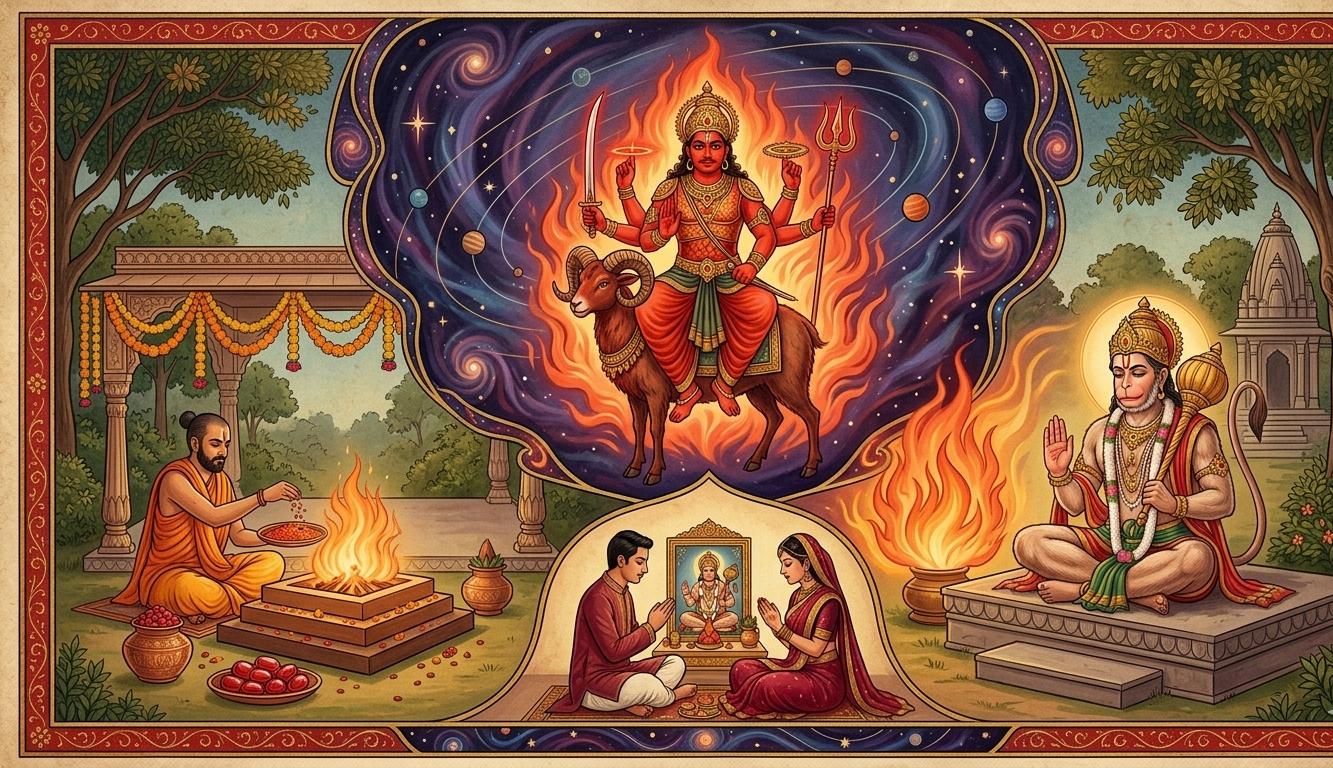
Kumbh Vivah: A symbolic ritual where the individual is “married” to a clay pot or a Vishnu idol to absorb the initial “fiery” transit.
Mantra Therapy: Chanting the Mangal Gayatri Mantra or the Hanuman Chalisa to channel Martian energy into devotion and strength.
Dana (Charity): Donating red lentils (Masoor Dal), copper, or red clothes on Tuesdays.
Fasting: Observing a fast on Tuesdays to discipline the digestive fire and the mind.
Conclusion
Manglik Dosha is not a mark of bad luck. It is simply an indication of a strong, fiery soul that needs to learn the art of compromise and emotional regulation. By understanding the placement and applying the right Upayas, a Manglik individual can lead a highly successful, energetic, and harmonious married life.
The key lies in matching the energy, not fearing the planet.
Short
Explore the profound science of Doshas in Jyotish. This guide breaks down common astrological imbalances like Manglik and Kaal Sarp Dosha, explaining them not as curses, but as karmic maps for personal growth and spiritual healing through Vedic remedies.”