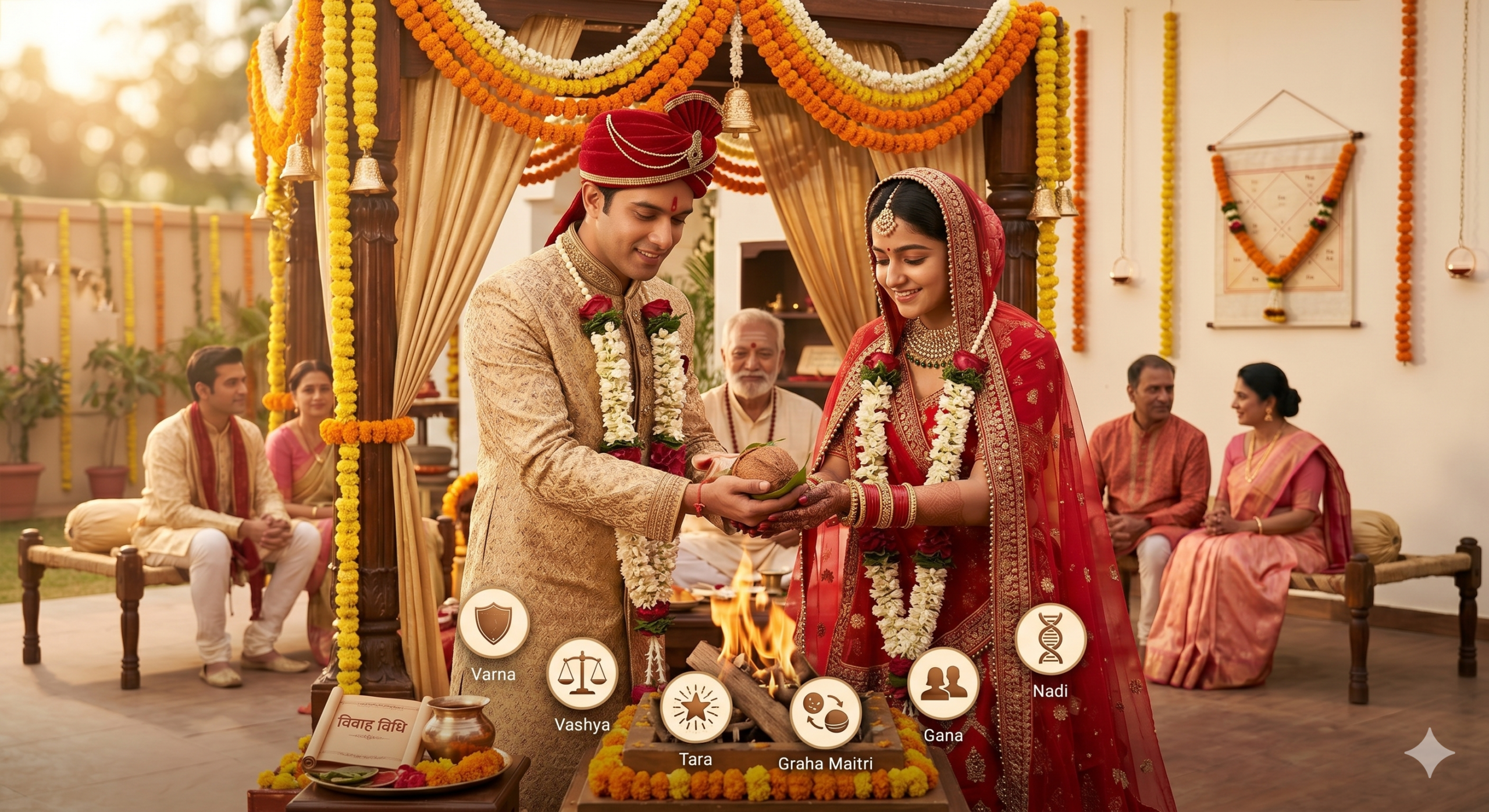
Ashtakoot Matching: An Essential Part of Horoscope Matching in Indian Astrology

Meta Description: Planning to get married? Discover why Ashtakoot Matching (36 Guna Milan) is a vital ritual in Vedic Astrology, how the 8 Koots affect your future, and its true significance.
In the rich tapestry of Indian traditions, marriage (Vivah) is not merely a legal or social contract between two individuals. It is considered a sacred, lifelong union of two souls, two families, and their karmic destinies.
To ensure that this profound union brings peace, prosperity, and longevity, Vedic Astrology introduces Kundli Milan (Horoscope Matching). At the absolute heart of this matchmaking process lies Ashtakoot Matching—a time-tested, 36-point compatibility scoring system that forms the foundation of marital analysis in Indian astrology.
If you are looking to understand how this ancient system works and why it remains indispensable even in the modern era, here is an in-depth guide to Ashtakoot Matching.
What is Ashtakoot Matching?
The word Ashtakoot is derived from two Sanskrit words: Ashta (meaning Eight) and Koota (meaning Aspects or Categories). Therefore, Ashtakoot Matching is the method of evaluating eight different aspects of compatibility between the bride (Kanya) and the groom (Var).
Each of these eight categories is assigned a specific weight or points (known as Gunas). When you add up the points from all eight categories, it totals 36 Gunas.
The Scoring Rule: In Vedic Astrology, a minimum score of 18 out of 36 Gunas is required for an acceptable match. A score above 24 is considered good, while a score above 30 is deemed excellent.
The 8 Koots and Their Hidden Significance
Each of the eight Koots analyzes a specific psychological, physiological, or spiritual dimension of the couple. They are calculated based on the positions of the Moon (Chandra) and the Birth Stars (Nakshatras) of both individuals at the time of their birth.
Here is the breakdown of the 8 Koots, arranged from the lowest weight to the highest:
1. Varna (1 Point) – Ego and Spiritual Development
Varna analyzes the spiritual and psychological capacity of the individuals. It classifies personalities into four categories (Brahmin, Kshatriya, Vaishya, and Shudra). It ensures that there is mutual respect and that neither partner tries to intellectually dominate the other.
2. Vashya (2 Points) – Mutual Attraction and Control
Vashya measures the degree of mutual attraction, influence, and the power dynamic between the couple. It determines who will be more dominant in the relationship and ensures that the couple maintains a balanced, harmonious equation without power struggles.
3. Tara (3 Points) – Destiny and Health (Nakshatra Compatibility)
Calculated from the birth stars, Tara Koot indicates the health, well-being, and longevity of the partners post-marriage. It highlights whether the cosmic energies of one partner will auspiciously uplift or adversely affect the other.
4. Yoni (4 Points) – Physical and Sexual Compatibility
Yoni represents biological compatibility and physical intimacy. It is symbolized by different animals (e.g., Lion, Elephant, Horse, Cat). Matching the Yoni ensures physical satisfaction, deep affection, and genetic compatibility between the couple.
5. Graha Maitri (5 Points) – Psychological Compatibility
This Koot checks the friendship and relationship between the planetary lords of the couple’s Moon signs (Rashi Lords). If the Rashi Lords are friendly (like Sun and Jupiter), it promises excellent communication, shared values, and intellectual bonding.
6. Gana (6 Points) – Temperament and Behaviour
Human temperaments are divided into three Ganas: Deva (Divine), Manushya (Human), and Rakshasa (Fiery/Demonic). Gana Koot ensures that the couple’s core nature and temperaments are aligned. Mismatches here can lead to severe behavioral conflicts.
7. Bhakoot (7 Points) – Emotional Bonding and Wealth
Bhakoot analyzes the relative positions of the two Moon signs. It directly impacts the emotional health, financial prosperity, and family growth after marriage. Mismatches in Bhakoot lead to Bhakoot Dosh, which can cause emotional distance or financial distress.
8. Nadi (8 Points) – Physiological Health and Progeny
Holding the maximum weight of 8 points, Nadi represents the physiological constitution (Vata, Pitta, Kapha) of the individuals. Matching the Nadi ensures the health of the couple and the successful continuation of the lineage (Progeny/Santan Sukh). A mismatch creates the dreaded Nadi Dosh.
Why Ashtakoot Matching is Essential, But Not the Final Step
For centuries, Ashtakoot Matching has served as an excellent preliminary screening tool. It instantly filters out profiles that have severe psychological or physiological friction.
However, modern Vedic Astrologers emphasize that while Ashtakoot Matching is essential, it is not the only step. To ensure a completely safe marriage, a comprehensive horoscope analysis must look beyond the 36 Gunas to check:
- Manglik Dosh (Kuja Dosh): To avoid severe energy and temperament clashes.
- The 7th House (House of Marriage): To assess the actual strength of marital bliss, loyalty, and longevity.
- Planetary Periods (Maha Dasha): To check if the couple is heading into a prosperous or turbulent timeline post-wedding.
Conclusion
Ashtakoot Matching is a profound testament to the psychological and scientific depth of ancient Indian Astrology. By evaluating everything from emotional wavelengths to physiological compatibility, it provides a beautiful blueprint for a balanced married life.
For anyone embarking on the beautiful journey of marriage, honoring the wisdom of Ashtakoot Milan alongside a comprehensive chart reading is the best way to invite cosmic harmony into their union.